
Shutterstock Image
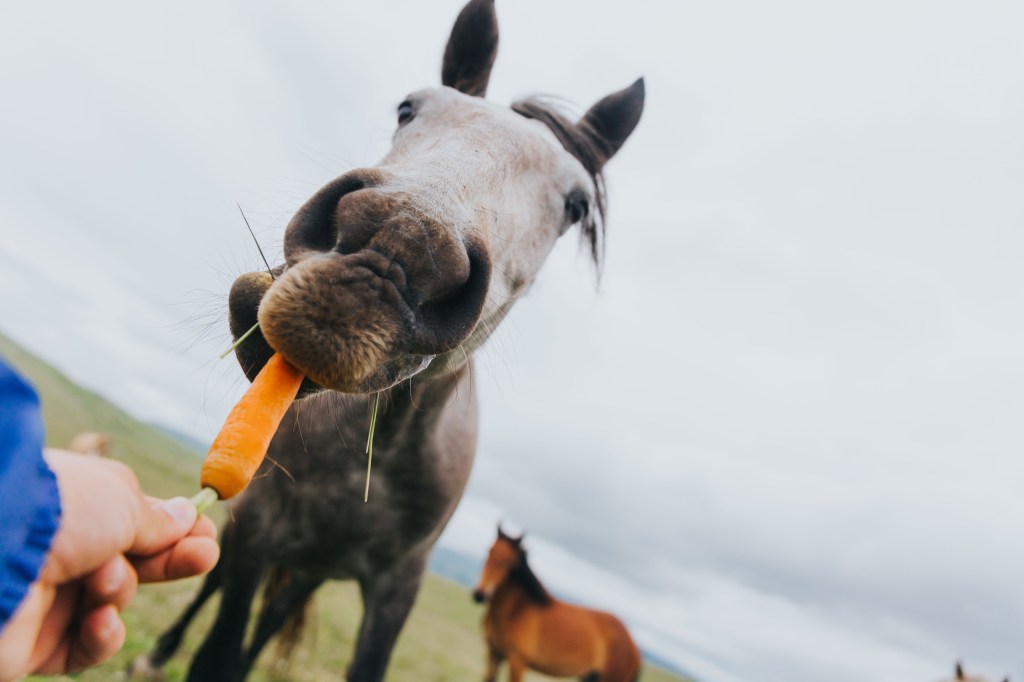
Breakthrough Science: Horses love carrots AND they’re good for them!
Hello fellow equine enthusiasts! As the President of Richdel, Inc., and someone currently surviving on coffee as an MBA candidate during Mid-Terms at the University of Nevada, Reno, I always appreciate when hard data backs up common sense. Case in point: a “groundbreaking” study recently confirmed that horses actually like carrots. Shocking, I know! But before we laugh too much at what seems like common equine knowledge, the science behind how they prefer them, and why they are so good for them, is genuinely fascinating.
The Great Carrot Taste Test
Researchers in Poland recently decided to see if all carrots are created equal to an equid. The study involved giving 21 leisure horses between the ages of 3 and 22 years a total of 5 preparations of carrots: raw, grated, boiled, dried and juiced.
The Results
Most horses appeared to prefer the raw, whole carrots and ate those first, followed by the grated and dried forms. Boiled carrots were the least popular. As for carrot juice, it was initially rejected by most horses, but its acceptability increased in later trials.The researchers concluded that the form of carrots offered to horses influences feeding behavior. So, skip the juicer and keep it simple!
The Nutritional Powerhouse
We know they love the crunch, but let’s dive into the literature to see why carrots are a nutritional home run.
Hydration and Fiber: According to both Nutrient Requirements of Horses (The National Academies Press) and Lon Lewis’s foundational texts, Feeding and Care of the Horse and Equine Clinical Nutrition, fresh carrots are incredibly high in water and easily digestible fiber. They provide a safe, low-calorie treat that supports healthy hindgut function.
High Palatability: Classic agricultural texts like Ensminger’s Feeds & Nutrition and Macmillan’s Applied Animal Nutrition classify carrots as succulent root crops. They are celebrated for their extreme palatability, often used to tempt picky eaters or hide less favorable medications.
A Deep Dive into Beta-Carotene: If we look at Eleanor M. Kellon’s excellent book, Equine Supplements & Nutraceuticals, we find the true magic of the carrot. Dr. Kellon highlights that effective nutraceuticals don’t always come in a processed tub. Carrots are packed with beta-carotene, a potent systemic antioxidant that helps scavenge free radicals generated during heavy exercise. Even better, beta-carotene is a provitamin. This means the horse’s body safely regulates its conversion into active Vitamin A, utilizing only what it needs for eye health, mucous membrane integrity, and immune support, completely eliminating the risk of Vitamin A toxicity.
So, the next time you toss your horse a raw, unpeeled carrot, you aren’t just spoiling them you are practicing evidence-based equine nutrition! On average, 100 grams of raw carrots (which is roughly two small-to-medium carrots) contains about 8,285 to 8,332 micrograms (µg) of beta-carotene. That translates to roughly 8.3 milligrams.
If you are just tossing your horse a single, standard-sized medium raw carrot, they are getting around 5,000 µg (5 mg) of beta-carotene. It’s a fantastic, natural dose of provitamin A! Because beta-carotene is a precursor to Vitamin A, the horse’s body will safely convert only what it actually needs filtering out the rest and completely avoiding the risk of toxicity. Drop a photo or story of your horse enjoying their crunchy carrot snack in the comments below.
Featured Research Study
Mańkowska A, Dobraczyńska BM, Szewczak J, et al. Preliminary assessment of leisure horses’ preferences for different forms of carrot (Daucus carota subsps. sativus). Animals. 2025:15(3385). https://doi.org/10.3390/ani15233385.
Equine Nutrition & Veterinary References
- Lewis, Lon D. Feeding and Care of the Horse. 2nd ed., Williams & Wilkins / Wiley, 1996. (Note: Originally published by Lea & Febiger, 1982).
- National Research Council (NRC). Nutrient Requirements of Horses. 6th Revised Edition, The National Academies Press, 2007. (Earlier editions also broadly referenced in clinical practice, e.g., 5th Rev. Ed., 1989).
- Ensminger, M. Eugene, et al. Feeds & Nutrition (also published as Feeds & Nutrition Digest). Ensminger Publishing Co., 1990.
- Cheeke, Peter R. Applied Animal Nutrition: Feeds and Feeding. Macmillan Publishing Company, 1991 (Later editions by Prentice Hall / Pearson).
- Lewis, Lon D., et al. Equine Clinical Nutrition: Feeding and Care. Williams & Wilkins, 1995. (Recently updated in a 2nd edition edited by Rebecca L. Remillard, Wiley-Blackwell, 2023).
- Kellon, Eleanor M. Equine Supplements & Nutraceuticals: A Guide to Peak Health and Performance Through Nutrition (also published as Horse Journal Guide to Equine Supplements & Nutraceuticals). Breakthrough Publications, 1999.
Sourcing:
Grimmway Farms – The Largest Producer of Carrots Globally https://www.grimmway.com

 Supporting Healthier Animals & Developing Successful People