
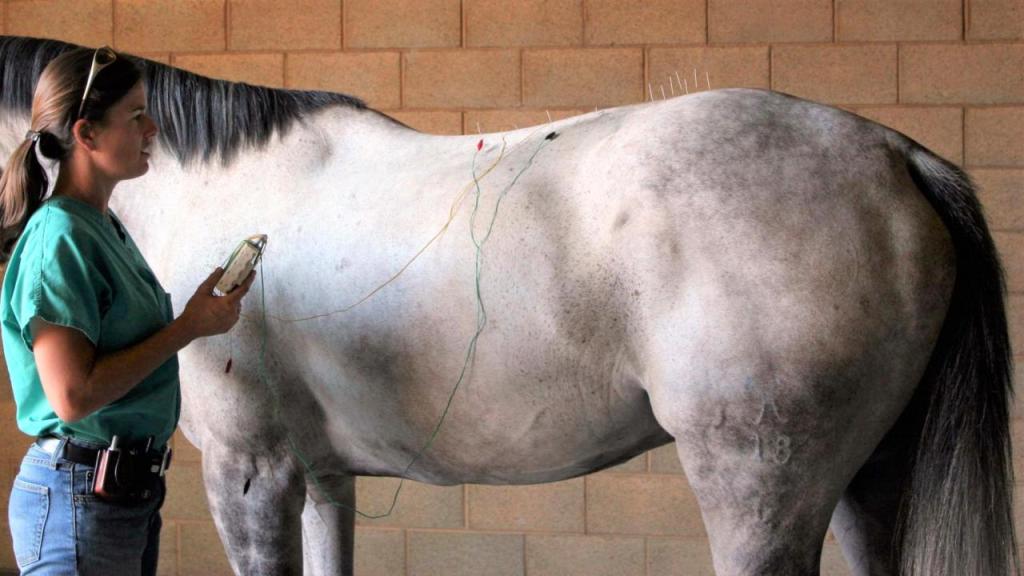
Image Courtesy of UC Davis Weill School of Veterinary Medicine Center for Equine Health
As the president of Richdel, my daily focus usually centers on the microscopic details of equine nutrition. I spend a significant amount of my time analyzing the precise ratios of amino acids, minerals, and vitamins that help our horses perform at their peak. However, my current journey as an MBA candidate at the University of Nevada, Reno, has trained me to look at the broader “market” of equine wellness through a lens of rigorous data and clinical efficacy. While I will always be a proponent of internal health starting with the feed ration, a recent report in the February 2026 issue of The Modern Equine Vet regarding alternative acupuncture modalities caught my eye because it bridges the gap between traditional holistic care and hard, evidence-based science.
In our industry, we are constantly seeking ways to manage thoracolumbar back pain, a frequent hurdle for performance horses that can lead to decreased mobility and a sour attitude. For years, acupuncture was viewed by some as a fringe benefit, but the latest research presented at the 71st AAEP Annual Convention in Denver provides the kind of data that even the most skeptical practitioner or horse owner can appreciate. The study, led by Dr. Kaitlin Sebring and her colleagues from the University of Florida and the University of Georgia, focused on comparing two distinct methods: electroacupuncture and laser acupuncture.
Electroacupuncture is a more modernized version of the traditional practice, where electrical stimulation is added to needles placed at specific anatomical points. Laser acupuncture, on the other hand, is a completely non-invasive, non-thermal modality that uses low-intensity light instead of needles. From a management perspective, the distinction between these two is fascinating. We often talk about “return on investment” in the contrast of supplements, but here the investment is in the comfort and cooperation of the horse. The researchers hypothesized that while both would provide relief, electroacupuncture might have a slight edge in performance, and the data supported this.
To measure pain relief objectively, the team used a pressure algometer to determine Mechanical Nociceptive Thresholds, or MNTs. In simple terms, a higher MNT indicates that a horse can tolerate more pressure at a specific site, which serves as a proxy for reduced pain. Both the electro and laser groups showed statistically significant increases in these thresholds by the end of the two-week study. Interestingly, the electroacupuncture group showed improvements almost immediately after the first treatment, whereas the laser group saw its most significant gains at specific sites like the L6 vertebrae by day four.
What truly resonated with me as a leader in the equine health space was the discussion regarding “needle-shy” horses. We all know that horse, the one that requires a team of handlers just to administer a routine vaccination. For these animals, traditional acupuncture can be more stressful than beneficial. Dr. Sebring pointed out that laser acupuncture offers a non-contact, shorter treatment time that could revolutionize care for sensitive patients. This is a classic example of “customer-centric” innovation in the veterinary world: finding a way to deliver the same anti-inflammatory cytokines and mesenchymal stem cell triggers without the stress of a needle.
Even though electroacupuncture remains the “gold standard” for deeper pain relief in this study, the emergence of laser therapy as a viable alternative is a win for equine welfare. It reminds us that whether we are formulated a new joint support supplement or choosing a recovery modality, the goal is to trigger the horse’s own repair systems naturally and effectively. As we continue to push the boundaries of what is possible in equine sports medicine, I am encouraged to see “alternative” treatments being held to such high academic and clinical standards. It makes it much easier for those of us in the industry to recommend a holistic approach when we can see the data points lining up as clearly as the points on an acupuncture chart.
If you have been curious about how to integrate these modalities alongside a strong nutritional foundation, I encourage you to consult with your veterinarian about which version of acupuncture might suit your horse’s temperament and physical needs. At Richdel, we believe that a balanced horse is a successful horse, and sometimes that balance comes from a little bit of light or a gentle pulse. Let’s keep looking for new ways to put the health of our equine partners first. Let me know your thoughts in the comments below.
References:
Sebring, K., Dockery, A. K., Phelps, L. M., et al. (2025). “Comparison of electroacupuncture versus laser acupuncture in horses with thoracolumbar back pain.” Journal of Equine Rehabilitation. This study provides the primary clinical data regarding the efficacy of MNT increases in treated horses. https://www.sciencedirect.com/science/article/pii/S2949905425000234
Kim, D. Y., Taylor, H. W., Moore, R. M., et al. (2003). “Articular chondrocyte apoptosis in equine osteoarthritis.” The Veterinary Journal. This reference supports the underlying biological need for anti-inflammatory interventions in managing degenerative joint. https://pmc.ncbi.nlm.nih.gov/articles/PMC3794750/


